
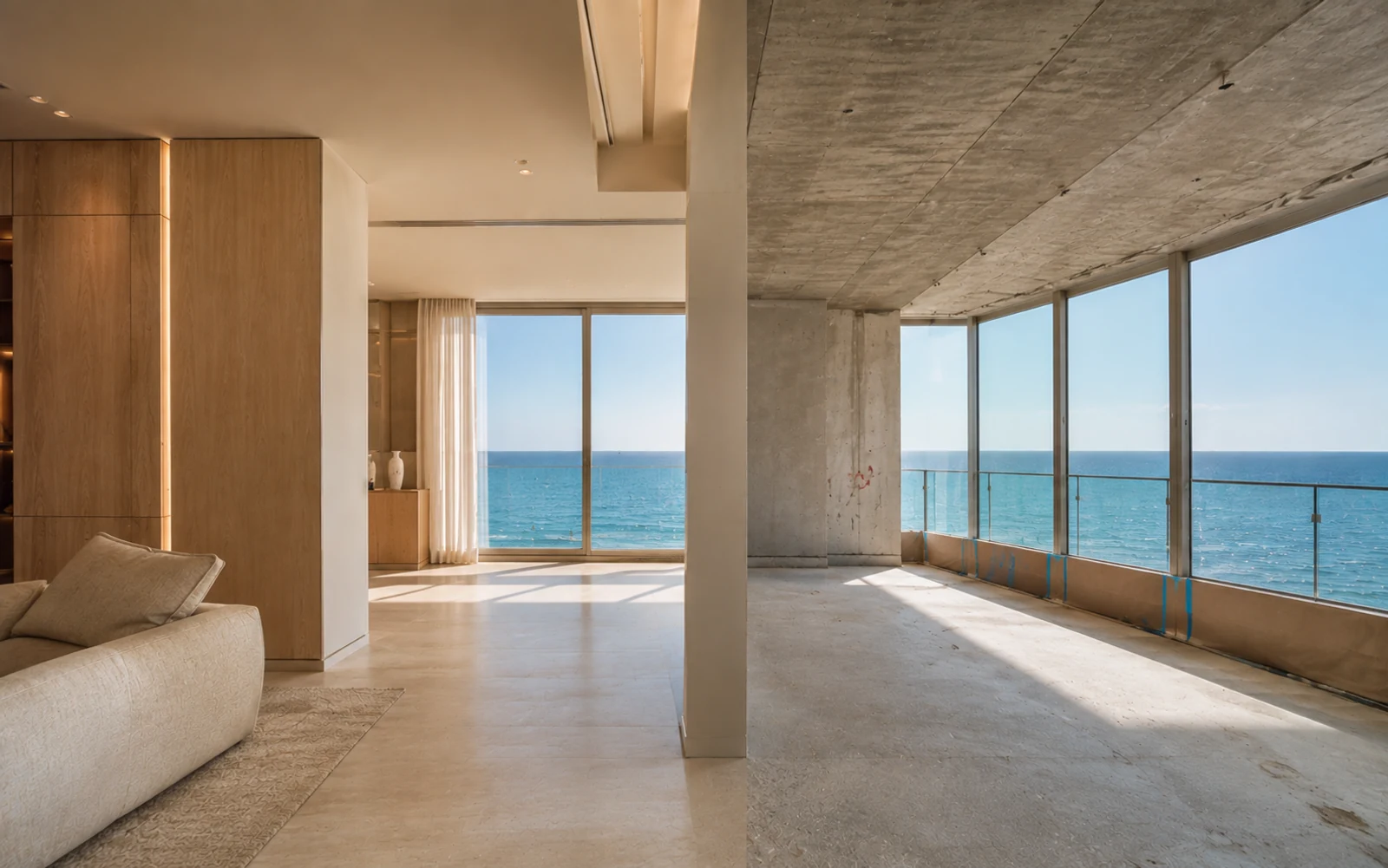
An oceanfront condo renovation cost is not a house renovation cost with a view attached. The building itself changes the arithmetic.
Most Miami renovation cost guides are written for houses. If you own a unit in a tower, they will under-budget your project, and the gap is not small.
Renovating in a condominium costs roughly 10% to 20% more per square foot than the same work in a single-family home. Not because the finishes are better. Because of everything the building imposes on the job.
Here is what the work actually costs, where the premium comes from, and the line items that appear on every tower project and almost no published guide.
Interior design cost per square foot, and what it includes
| Scope | Cost per square foot, Miami |
|---|---|
| Condominium renovation, general | $80 to $220 |
| Single-family home, equivalent work | $100 to $300 |
| Comprehensive gut renovation | $175 to $250+ |
| Coastal luxury | frequently $250 to $300+ |
| Comprehensive service, including furnishings | $200 to $350 |
Worked example, published market figure: a full renovation of a 1,200 square foot condo commonly lands between $175,000 and $270,000, including association review fees and elevator deposits.
Scale that. An oceanfront unit of 3,000 square feet at coastal luxury rates is a very different conversation, and it is the conversation most owners of waterfront property in Miami Beach, Sunny Isles, Bal Harbour, Brickell and the Fort Lauderdale beach corridor are actually having.
Where the condo premium comes from
None of it is finishes. All of it is logistics.
Restricted working hours. Most towers permit work on weekdays only, within a defined window, and many impose blackout periods in high season. A crew that can work 30 hours a week instead of 50 is a crew that costs more per unit of progress.
Elevator scheduling. Every delivery and every removal is booked. Trades wait. Waiting is billed.
Protection of common areas. Corridors, lobby and elevator cab all have to be protected and restored. That is labour and material with zero visible result inside your apartment.
No lay-down space. In a house, material sits in the garage or the yard. In a tower there is nowhere, so deliveries are staged just-in-time, which costs more and is more fragile.
Debris removal. Every load goes down the service elevator, through a protected route, to a scheduled dumpster.
Parking. In a dense tower, trades sometimes cannot park at all. That is time on the clock.
Association compliance. Documentation, insurance certificates naming the association, permits held before access, and a pre-construction meeting.
Fixed points that cannot move. Plumbing risers and structural elements are not negotiable, so detailing works around them. In a post-tension slab, core drilling for a relocated drain may be prohibited outright, which changes the design rather than the price.
The line items nobody publishes
| Item | Range |
|---|---|
| Association architectural review fee | $500 to $2,500 |
| Elevator deposit | $500 to $1,500 |
| Security deposit against common-area damage | Varies, refundable |
| Municipal permits | By scope, obtained by the contractor |
| Structural engineer's letter | Required wherever walls or the slab are affected |
Individually modest. Collectively they are the difference between a budget that holds and one that does not, and they never appear in a general Miami cost guide.
The big one: the special assessment
This is the single largest financial risk to an oceanfront renovation, and it has nothing to do with your contractor.
Miami-Dade now requires building recertification at 30 years, or 25 years within roughly three miles of the coast. Nearly every oceanfront tower in this market is inside that three-mile band.
When a building goes through recertification, the common findings in coastal towers are concrete restoration, balcony reconstruction, window and railing replacement and electrical upgrades. These are funded by reserves or by special assessment, and published examples in Miami have reached six figures per unit.
The assessment and your renovation compete for the same money. An owner who commits to a full renovation the month before a large assessment lands is an owner who pauses the project halfway through, which is the most expensive way to renovate anything.
Before budgeting, find out where your building sits in its cycle. It is one question to the association and it can change the entire plan.
The other risk: paying twice
If your building is going to replace windows, sliders or balconies, anything you build that touches them will be cut out and rebuilt.
The elements at risk:
- Millwork built tight to a slider track
- Stone or tile returns at window reveals
- Curtain pockets sized to the existing head height
- Balcony flooring, ceilings and built-ins
- Façade-facing wall finishes
- Motorised shading tracks
The strategy that saves the money: split the project. Do the interior work now, hold the envelope-adjacent work until the building's scope is known. Most of an apartment is interior work, so this is far less limiting than it sounds.
Building a realistic budget
1. Establish the square footage you are actually renovating. Not the unit size on the deed, the area being worked.
2. Pick the rate band honestly. $80 to $220 covers a wide spectrum. Coastal luxury with custom millwork, stone and imported fixtures sits at $250 and above, not at $120.
3. Add the administrative line items. Review fee, elevator deposit, security deposit, permits, engineer's letter.
4. Add contingency. In a tower, behind-the-wall conditions are unknown until demolition. Older buildings surprise people.
5. Check the recertification cycle before committing. If an assessment is coming, size the project against what will be left, not against today's balance.
6. Decide furnishings separately. Comprehensive service at $200 to $350 per square foot includes goods. A construction-only number does not.
Where the money goes: interior design fees per square foot, line by line
Rough shape of a high-end tower renovation, useful for sanity-checking a proposal rather than as a formula:
| Category | Notes |
|---|---|
| Kitchens and bathrooms | The most expensive rooms per square foot by a wide margin. Plumbing, tile, stone, cabinetry and appliances all concentrated |
| Millwork and joinery | Custom is drawn, shop-reviewed and installed. It is where high-end budgets go |
| Stone and tile | Material cost plus fabrication plus skilled installation |
| Flooring | Plus the acoustic assembly your building requires, which is not optional |
| Electrical and lighting | Higher than owners expect once lighting design is involved |
| Paint, plaster and finishes | Modest in material, significant in labour |
| Design fee | Typically the smallest of the major categories |
What the building's age tells you before you see a single bid
Two identical apartments, same square footage, same finishes, can differ by a wide margin in renovation cost for one reason: the building behind the walls. You can read most of that before a contractor ever walks the unit.
Buildings from the boom of the last fifteen years. Generally the least expensive to renovate. Plumbing and electrical are modern, riser capacity is documented, ceiling heights are generous and the association usually has clear written alteration procedures. The constraint here is rarely the building, it is the board's design standards for anything visible from outside.
Buildings from the eighties and nineties. The middle case, and the one where surprises live. Cast iron waste stacks may be near the end of their service life, electrical panels may not support the load a modern kitchen asks for, and the original drawings may or may not reflect what was actually built. The cost driver is discovery: what you find after demolition.
Older mid-century and earlier buildings. The most variable. These can be a pleasure to work in, with solid construction and proportions nobody builds any more, or they can carry an accumulation of undocumented modifications by previous owners. Concrete restoration work on the building itself is more likely to be in progress or imminent, and that governs your schedule whether you like it or not.
What to ask for before budgeting. The association's alteration guidelines, the age of the building's plumbing risers and electrical service, whether any structural or concrete restoration is planned in the next three years, and whether the unit has been renovated before and under what approvals. Those four answers move a cost estimate more than any finish selection.
Salt air, and the specification decisions it forces
An oceanfront apartment is a marine environment with furniture in it. Materials that perform for a decade three miles inland can fail within a few seasons on a high floor facing the water, and replacing them is a second renovation nobody budgeted.
Metal is where it shows first. Hardware, hinges, fixtures, light fittings, anything with an exposed metal finish. On a terrace or near a regularly opened slider, standard interior-grade hardware corrodes. The specification answer is marine-grade stainless or solid brass and a realistic expectation about lacquered finishes, which do not survive salt exposure regardless of what they cost.
Fabric and upholstery. Humidity plus salt plus intense light is a demanding combination. Performance fabrics have improved enormously and no longer look like compromise, but the selection has to be deliberate. This is one of the places where a specification made for a mainland home and applied to a beachfront apartment simply does not hold.
Stone and grout. Porous stone on a terrace or near an entry that tracks sand is a maintenance commitment. Sealing is not a one-time event.
Wood. Movement is the issue. Solid wood in a space with wide humidity swings, particularly if the apartment sits empty and unconditioned for part of the year, moves. Engineered products and stable species exist for exactly this reason.
The budget consequence. Marine-appropriate specification is not dramatically more expensive at the point of purchase. It is dramatically less expensive over the life of the interior, and the owners who learn this the hard way are the ones who furnished a seasonal apartment as though it were a primary residence in a stable climate.
Phasing a renovation, and what it really costs
Owners frequently ask whether they can split the work: kitchen this year, bathrooms next, furnishings after. The honest answer is that phasing is sometimes the right decision and it is almost never the cheap one.
What phasing costs you. Every phase repeats the fixed costs. A new board application, a new elevator booking and deposit, a new protection installation, a new mobilisation for a crew that has to relearn the unit. In a tower those fixed costs are substantial, and paying them three times instead of once erases most of what phasing appears to save.
It also multiplies disruption. Three separate periods of building access, noise restrictions and neighbour tolerance rather than one. In buildings with strict work-hour rules, this is not a small consideration, and neighbour goodwill is a finite resource.
The sequencing trap. Some work simply cannot be split without waste. Electrical and plumbing that serve multiple rooms have to be opened once. Flooring that runs continuously through the apartment cannot be laid in thirds without visible seams and a colour match nobody can guarantee across dye lots and years.
When phasing genuinely makes sense. When the apartment is occupied and cannot be fully vacated. When a genuine cash-flow constraint means the alternative is not a phased project but no project. And when the phases are naturally independent: a self-contained guest suite, a terrace, a furnishings package that follows a completed construction phase.
The version that works. Design the whole apartment once, permit and build the infrastructure once, and phase only the visible finishing and furnishing. That captures most of the cash-flow benefit without paying the fixed costs repeatedly or building something that has to be reopened. It requires deciding the whole scheme up front, which is the part owners resist and the part that makes it work.
Your neighbours are a budget line
In a house, the people nearby are a social consideration. In a tower they are a cost variable, because the apartments above, below and beside yours are physically part of your project.
The unit below. Everything wet in your apartment sits above someone's ceiling. Any work touching plumbing raises the question of what happens if it leaks, and the answer is that you are responsible for the damage. This is why boards require insurance and why professional waterproofing in wet areas is not the place to economise. A leak that damages the unit below costs more than the entire waterproofing budget, several times over.
The unit above. Their plumbing runs through your ceiling. If you are opening ceilings anyway, that is the moment to look at what is up there, because you will not have this access again cheaply. Owners who discover a failing connection above their new kitchen ceiling six months after completion pay twice for the same work.
The units beside you. Shared walls carry sound, and sound is what generates complaints. Complaints generate board attention, and board attention mid-project is a schedule risk. The controllable part is scheduling noisy work within permitted hours and telling neighbours in advance, which costs nothing and prevents a surprising amount of friction.
The occupancy pattern matters too. A building of primary residences has neighbours present all day and a low tolerance for noise. A building of seasonal owners is quieter in summer, which is frequently the best window to work in. Ask the management company what the building's rhythm actually is. It is a free input that can reshape a schedule.
The apartment you can renovate affordably, and the one you cannot
Before committing to a budget, it is worth knowing which category your unit falls into, because the difference is decided by conditions you inherit rather than choices you make.
The affordable version. The layout works and you are not moving walls. Kitchen and bathrooms stay approximately where they are, so plumbing connects to existing stacks. The electrical panel has capacity. The building has clear alteration rules and a board that meets monthly. In this apartment, nearly all of your budget converts directly into visible quality, which is the best possible ratio.
The expensive version. The layout is wrong and fixing it means relocating wet areas away from existing stacks. That single decision cascades: new drainage requires slope, slope requires either a raised floor or coring through structure, and coring through structure in a condominium requires engineering, association approval and sometimes is simply not permitted. Add an electrical service that will not support the specification, a board that meets quarterly, and concrete restoration scheduled during your build.
The honest reframe. If your apartment is the expensive version, the question is not how to renovate it cheaply. It is whether the layout change is worth what it costs, and that is a genuine decision with a defensible answer either way. Many owners, shown the real number, choose to spend the same money on exceptional finishes and furnishings within the existing layout and end up with an apartment they prefer.
How to find out which one you have. Before you commission a full design, get a walkthrough with someone who has worked in your building and ask one question: what would it take to do what I want, and what would you not attempt here? An experienced answer to that question is worth more than three optimistic bids.
Seasonal ownership changes the calculation
A large share of oceanfront apartments in Miami and Fort Lauderdale are not primary residences. If yours is seasonal, three things about the budget change.
The empty months are your construction window. This is the significant advantage of seasonal ownership and it is frequently wasted. Work carried out while you are away costs you no displacement, no hotel, no living around a construction site. It also means the schedule has a hard boundary, which concentrates everyone's attention usefully. The requirement is deciding early enough that permits and long-lead goods are ready when the window opens, and long-lead items are measured in months.
An unoccupied apartment behaves differently. Left closed and unconditioned in a South Florida summer, humidity does real damage to wood, upholstery and finishes. Specification for a seasonal apartment should assume months of closure, and the mechanical decisions that manage humidity while nobody is there are worth more than they cost.
Furnishing priorities shift. A seasonal apartment is used intensively for short periods, often by guests and extended family. Durability and how the space handles more people than a primary residence typically matters more than day-to-day domestic detail. Owners who furnish a seasonal apartment exactly as they would a permanent home usually find the balance wrong within two seasons.
The oversight question. A renovation you cannot visit needs somebody accountable on site. That is a real service with a real cost, and the alternative, approving finish decisions from photographs sent by a contractor, is how expensive misunderstandings happen. Budget for supervision rather than discovering you needed it.
The short version
| Condo, general | $80 to $220 per sq ft |
| Gut renovation | $175 to $250+ |
| Coastal luxury | $250 to $300+ |
| Condo premium over a house | +10% to 20% |
| Review fee + elevator deposit | $1,000 to $4,000 combined |
| 1,200 sq ft, full renovation | $175,000 to $270,000 |
Budget from a condo guide, not a house guide. Add the administrative items. And check the recertification cycle before you commit a dollar.
Working out what your unit will cost?
Send us the building, the approximate square footage and where the building sits in its recertification cycle. We will tell you the realistic range for that specific tower and which parts of the work should proceed now.
Figures are published market ranges for South Florida gathered in 2026, not any single firm's pricing. Every building imposes its own requirements and every project is priced on its own scope.
Jorge Castillo Design designs high-end residential interiors across South Florida, including oceanfront condominiums and penthouses in Miami, Miami Beach and Fort Lauderdale.